AI: The Least Secret Secret

Here’s a version that sounds a little less ‘AI’:
Marketing sites. Emails. LinkedIn posts about how to "harness" it — written, of course, by the very thing they're harnessing.
The same tone. The same cadence. The same staccato structure. Reads clean. Says nothing.
Here's the part that nobody realises: You probably drafted something in Claude today. It went out. It landed in someone's inbox, someone's feed, someone's pitch deck. And whoever received it? They knew.
Because this isn't just a shift in how we write — it's a shift in how we're read.
In today's fast-paced content landscape, the question is no longer whether you're using AI. It's whether you're actually using it well. And that changes everything.
Ok ENOUGH. So let's stop pretending. We all use it. We're all a little bit addicted. Which means it's time for the three-step programme.
No one is above it. The hand that was once so subtle has become almost brazen. In June 2026, New Brunswick MLA Bill Oliver read AI editing instructions aloud to the legislature, not once but twice, including the line "here's a more natural, flowing version of that section that reads like a legislative speech rather than a series of short points." Nobody had checked the script closely enough to notice the prompt was still in it. AI use is now ambient enough that its instructions can survive a formal government address.
Here is the thing brands keep forgetting. Offensive copy and distorted AI visuals assume an ignorant audience, one that can't spot a synthetic face or a suspiciously tidy sentence. But that audience has the same tools and the same media literacy the brand does. They have been staring at the same outputs for three years. Keep that in mind, because everything below depends on it.
Step One: Awareness
If we are going to use the drug, the first step is knowing what it looks like. Before you can decide anything, you need to be able to spot it.
Ask any AI model to write about the impact of something and it will hand you the same three-beat rhythm almost every time: short, punchy, detached. Here's a real example, lifted from LinkedIn, about a founder's reluctance to go with what his team thought was right:
→ "He needed convincing. They built it anyway. It worked."
You can't deny it reads well. It's rhythmically satisfying, almost a song. It is also completely detached from any actual person, moment in time, or stake, which is exactly what gives it away. Once you've seen the pattern a few times you can't unsee it: the tricolon close, the clipped sentences doing the emotional work a specific detail should be doing, the sense that the copy is performing sincerity rather than having it.
Now the other tell, and the one that caught Nike out. In May 2026, in a perfectly innocuous post on X celebrating Jannik Sinner's run of titles, Nike closed with: "This isn't just history — it's his story in the making." One user replied asking how a GPT AI-ism had slipped through on Nike's main page, and hundreds piled in behind them. Fast Company, covering the pile-on, pointed out that the "it isn't X, it's Y" construction predates AI by decades, and that the evidence was thin.
That is the point. It's all there anyway: the "not X, it's Y" pivot, the em dash, the wordplay that sounds like a line but has no specific detail underneath it. "His story in the making" is doing the job a stat or a moment should be doing. Whether or not Nike used a model doesn't matter. The audience assumed it did, and the brand took the penalty either way.
So, the awareness audit: does it lean on a tricolon? Does it pivot on "not X, but Y"? Could you delete the em dash and lose nothing? Is there a single specific detail a human would have had to know? If the answers are yes, yes, yes and no, you know what you're holding.
Step Two: Make a Decision
AI is not a cure-all for every question of copy, branding and messaging. Diagnose the issue, then decide which of three routes you are taking. And take that decision on the assumption that we already know you've used it. The only real question is whether you want that to be clear.
Route one: invisible. If you need to blast out content at scale, use it. There is stuff AI is really good at: the stuff that doesn't need to perform, the stuff that doesn't need to stand out. Metadata, variants, the fortieth version of the product description. Nobody is reading it for the prose. But, with due respect, if there's a copywriter who thinks ChatGPT's latest draft is the finished ad, I would suggest they weren't a very good copywriter in the first place.
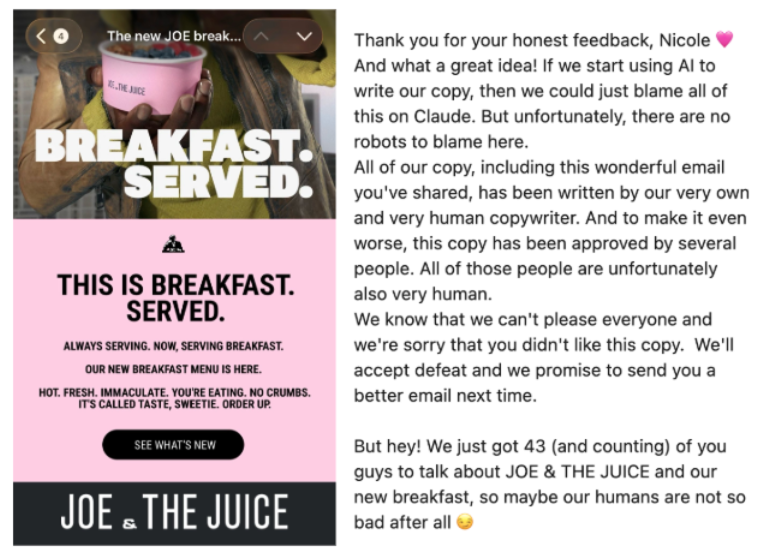
Route two: visible and owned. Lean into the AI copy and make the AI the story. Joe & The Juice did this with its Serving campaign, running deliberately synthetic-looking work and letting the internet argue about it. The age-old idiom of "all press is good press", with the machine as the press agent. More on this in Step Three.
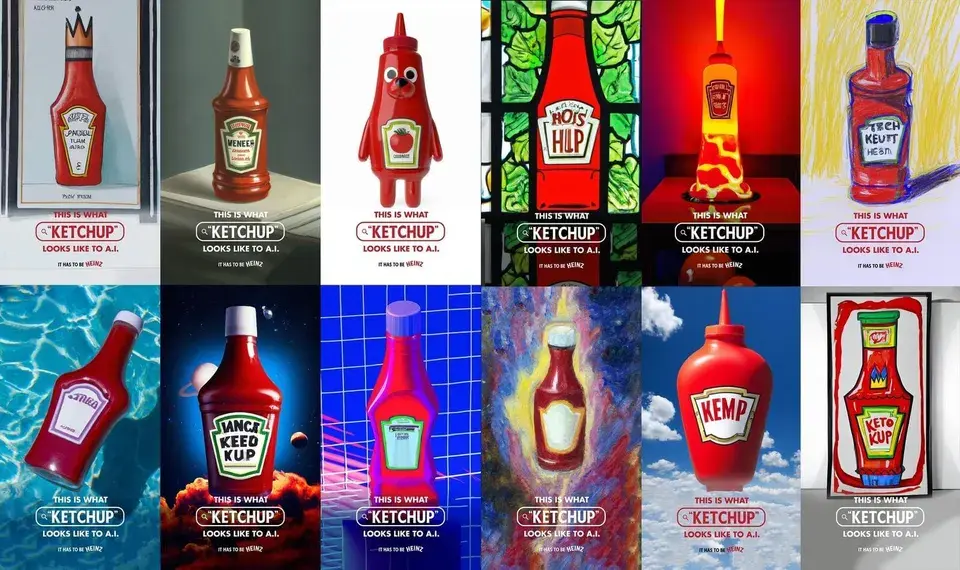
Route three: visible refusal. A freelance copywriter posted a spec ad for Parker pens on LinkedIn with a pointedly anti-AI tone, reframing the pen as a tool for authentic human thought at a moment when audiences are exhausted by synthetic content. It caught on. A creative community and an ad-testing agency turned it into an open contest, and nearly 350 people submitted billboard concepts in the same spirit. Parker's owner credited every contributor by name and put the winning ideas up on a digital billboard in Times Square within days. Research cited alongside the campaign found that eight in ten people don't believe brands when they explain their AI use; they assume it happened because it was cheaper, whatever the brand says.
Not using the tool at all is a creative decision, not an abstention. Done on purpose and out loud, it is exactly as effective as the alternative.
Step Three: Utilisation
The aim is not to be hidden but to be effective. And sometimes the most effective move is to show your hand rather than hide it.
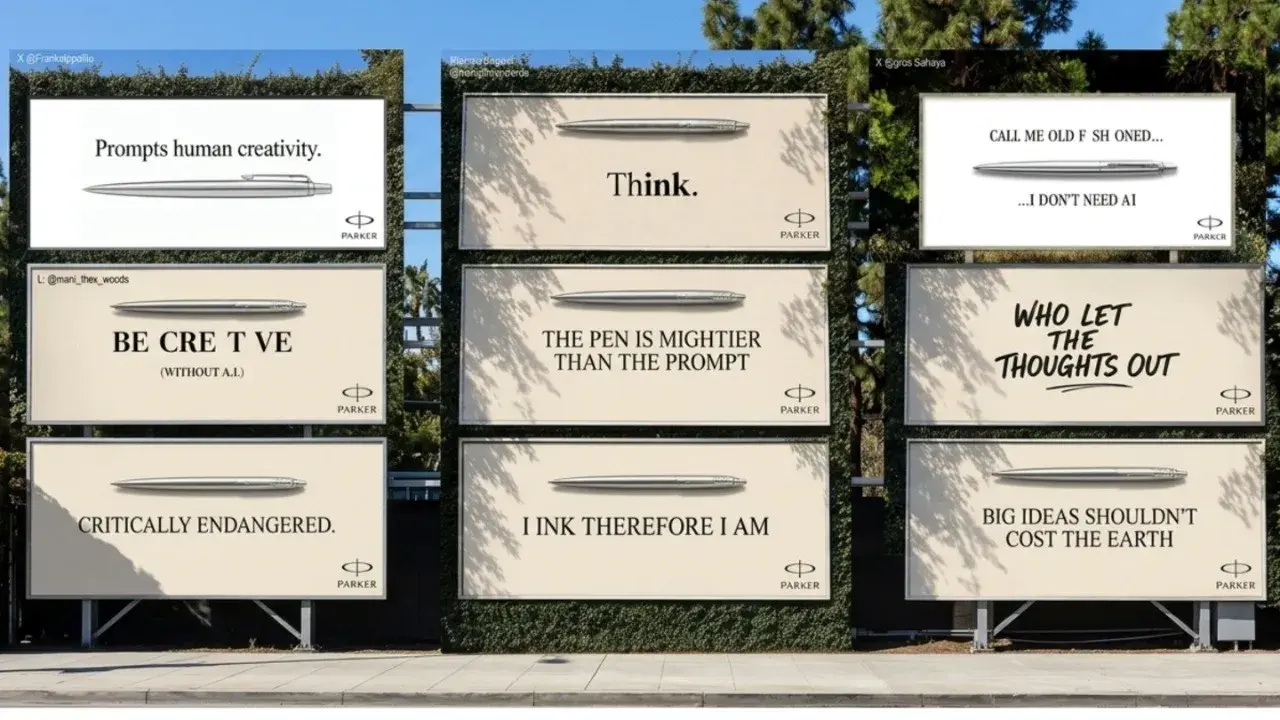
Heinz did this first. The brand fed the single word "ketchup" into an image generator and, without any extra prompting toward its own branding, the outputs kept landing on something unmistakably close to Heinz's own bottle. Heinz built a campaign around it, the AI's blind guess doubling as proof of how deeply the brand's design lives in the cultural imagination.
Joe & The Juice did the noisier version: rather than proving the brand lived inside the machine, it let the machine's weirdness become the brand's tone of voice for a season, and the comment sections did the media buying. And Parker, from the other direction, made the absence of the tool the entire creative idea. All three are the same move. The AI isn't laundered out of the final product. It, or its conspicuous absence, is the central focus rather than a sly secret tucked away.
Done well, this is what utilisation looks like. Done badly, it looks like a legislator reading his prompt into the parliamentary record.
At the risk of joining the echo chamber of "harnessing AI" and "expediting processes through AI", it cannot be stressed enough how useful the tool is, and how obvious it is when it's used badly. The people reading your copy have the same drug in their pocket. They know the dosage. Assume they can tell, and act accordingly.